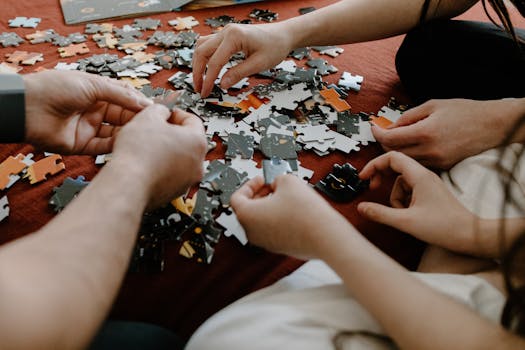
Everyone knows the rush of piecing together a tough puzzle under time pressure. That lightning bolt of insight shows why the best games encouraging creative problem solving have a powerful following.
Watching someone rethink their strategy mid-game, you begin to appreciate the role these games play beyond entertainment. Here, players merge experimentation and logic for real-life benefits.
If you want to sharpen your creative problem solving skills and discover games that provide hands-on practice, continue reading for practical examples that go beyond theory.
Building Stepwise Thinking With Pattern-Based Games
Stepping into pattern-based games, players quickly learn to spot connections others might miss. With each round, you’ll feel your creative problem solving improve as new patterns emerge.
The right move at the right moment feels satisfying, much like turning a key in a lock. Games like these naturally teach productive trial and error—try, fail, adapt, and repeat.
Discovering Sequences To Unlock New Paths
In games such as “The Witness,” a player notices the same sound as they trace different puzzle lines. They realize the sound hint appears only on correct paths.
When a player says, “When I hear that chime, I know I’m close,” they’re connecting cause and effect. Creative problem solving involves listening for cues and adjusting real-time.
You can replicate this in other games by looking for subtle effects—visual flashes, vibrations, or character gestures—each time you try a new approach. Use those signals to inform your next move.
Using Analogies To Build Transferable Skills
Pattern-heavy games mirror organizing a cluttered closet, where every item needs a designated spot. Each time a piece fits, you gain a sense of order and develop repeatable systems for any problem.
Try thinking, “What previous puzzle had a structure like this one?” This step pushes your brain toward flexible, creative problem solving by encouraging you to shift strategies across new challenges.
The mental habit reinforced here—scanning, matching, and iterating—maps directly onto daily planning, say, arranging errands to minimize car rides or sequencing tasks for efficiency.
| Game | Pattern Style | Core Mechanic | What To Try Next |
|---|---|---|---|
| The Witness | Visual-Sequencing | Line-drawing Path Solutions | Listen for unique sound cues while tracing |
| Lumines | Music-based Patterns | Block Rotation Alignments | Time moves to the song beat |
| Minecraft (Redstone) | Logic Circuit Construction | Component-based Puzzle Chains | Copy a clock circuit; change variables one at a time |
| Opus Magnum | Molecular Engineering | Programmable Automation | Test smaller modules separately first |
| Sokoban | Spatial Rearrangement | Box Pushing Sequences | Undo moves frequently to spot optimal paths |
Designing Multiple Solutions Through Sandbox Play
Sandbox games don’t force a single answer. Here, creative problem solving flourishes because players set their own constraints, like building spaceships that fly using only a handful of odd-shaped parts.
Adapting plans on the fly, you naturally learn to prototype and tweak like a designer in a product lab. Mistakes become opportunities for new experiments.
Embracing Constraints To Fuel Creativity
Consider a typical dialogue: “I want to cross this river, but only have wood planks and rope.” The player tries a raft, then a bridge, finally crafting a zipline using both.
Working within these limits, you grow inventive without waiting for hints. This routine primes your mind for real-world creative problem solving challenges involving resource management.
- Pick tight building or resource limits—forces you to test outside-the-box ideas and boosts creative problem solving when you have fewer tools.
- Start projects with intentional restrictions (no symmetry or set time constraints), training yourself to adapt quickly instead of relying on familiar routines.
- Collaborate on shared designs; alternate builders every minute for dynamic blends of ideas and spur quick, creative problem solving adjustments.
- Divide the screen into zones for team creativity—swap zones halfway and optimize each other’s unfinished work.
- Attempt a challenge with random tool assignments, increasing exposure to new techniques useful for lateral creative problem solving.
Keeping the process engaging lets you find new approaches every session. Add quirky self-imposed rules to steady improvement and unexpected discovery.
Documenting Experiments For Future Reference
Recording short clips or screenshots of wild prototypes lets you revisit your learning journey. Later, compare successful versus failed attempts for objective growth.
- Save distinct building phases—see how your creative problem solving persists through setbacks and which unplanned steps had surprising payoff.
- Write one-sentence notes beside snapshots: “Fails when loaded to one side,” or “Strongest under triangular supports.” Skim later to spot patterns.
- Collect the best community solutions. Analyze why their builds succeed—apply those lessons with a small twist for your next attempt using creative problem solving.
- Share highlight reels with friends; their reactions point out creative tweaks and suggest overlooked angles.
- Use a color code checklist for recall—label green for repeat, red for rework, and yellow for ideas to test again for smarter future creative problem solving.
Each step reinforces the idea that progress relies on reflection and playful self-challenge. Before long, creative problem solving feels instinctive through practice.
Practicing Open-Ended Planning With Puzzle Adventures
Open-ended puzzle adventures slowly build your strategic thinking, as they rarely offer immediate solutions. You’ll see patience and methodical creativity rewarded through clever design.
Immersed in these worlds, creative problem solving becomes a steady part of play. Your mindset shifts from rushing answers to understanding how each system interacts.
Charting Map-Based Progression Steps
Using a notebook, jot down physical clues or icon patterns as you explore. This external record-keeping keeps momentum even after a break, ensuring you don’t repeat mistakes.
A stepwise log—”blue button opens door B, but only when circuit C is powered”—mirrors workplace troubleshooting or group planning. Familiar routines surface everywhere, reinforcing your creative problem solving process.
Pausing to review notes before every session, you reclaim lost details and plan the next few moves, building confidence in your organization and memory.
Reframing Obstacles As Mini-Games
Players regularly rename roadblocks: “That’s not a problem—it’s a side quest.” Recasting challenges as adventures injects enthusiasm back into problem solving.
You carry that mental reframing into real life. When met with stuck elevator doors, you think, “It’s a logic puzzle.” That framing boosts creative problem solving and patience.
Letting yourself enjoy the smallest win—”I guessed the code by paying attention to scratches around the buttons”—translates to applauding cleverness in daily tasks, too.
Adapting and Iterating in Real-Time Strategy Environments
Jumping into real-time strategy games pushes quick thinking and on-the-go adaptation. You’ll tune your creative problem solving as surprise events demand fast plan changes.
These environments reward those who notice shifting enemy patterns or sudden map changes. Spotting the anomaly leads directly to advantage, giving your decision-making agility a workout.
Analyzing Foe Tactics Step by Step
Picture a tense moment: a player whispers, “That flank rush means their main defense is weak—deploy scouts now.” Noticing these openings comes from practiced creative problem solving.
Pause the action briefly to dissect: “After three quick attacks, they pause. That’s when I strike.” Linked observation and anticipation drive a smarter, evolving strategy.
Mark down what worked after each round, even if a move barely succeeded. Those insights layer up, giving future games a distinct edge through repeated creative problem solving.
Piloting New Tactics Mid-Battle
Mid-match, execute a quick switch—move defenses from ground to air as soon as a new enemy pattern emerges. Accept you won’t always win, but notice new lessons.
When your friend says, “I never thought to block that river path,” ensure both of you talk through the trade-offs. Playing together this way upgrades collective creative problem solving.
Replaying situations with different tactics—sometimes just swapping positions—cements your ability to make split-second, creative decisions even under stress.
Sharpening Teamwork with Cooperative Game Designs
Collaborative titles demand clear communication, trust, and a unique split of tasks. Immediate feedback helps everyone refine behaviors and blend ideas for optimal creative problem solving.
You’ll trade roles between rounds, try unfamiliar responsibilities, and celebrate small wins that come from group improvisation—not just individual skill refinement.
Syncing Group Strategies On The Fly
Make teamwork productive: One player shouts, “I’m taking the left lever, ready on your count!” While another designs, “Let’s split the resources: I mine, you build.”
Review victories and misfires together. “We won because you took initiative with the bonus item,” versus, “We stalled by over-explaining—next time, trust the plan.”
Groups that consistently debrief—even a one sentence “great call on defense!”—keep their creative problem solving fresh and everyone engaged over repeated sessions.
Resolving Stalemates Without Arguments
Instead of getting stuck, establish a ground rule: “Vote for the next move, no hard feelings.” The process moves forward, and creative problem solving is protected from heated debates.
Offer mini checklists: “Did we all hear the clue? Did we consider the timer?” This routine stops misunderstandings before frustration creeps in, leading to joyful, constructive sessions.
Finish each co-op round by giving everyone a small role shift. By rotating through tasks, creative problem solving spreads across the whole team, preventing habits from becoming rigid.
Thrive With Ongoing Creative Practice
Games remain one of the best arenas for building sharpened minds and nimble planning. Every session spent chasing creative problem solving leaves you more adaptable for life outside the screen.
Using pattern games, sandboxes, strategy, or teamwork, you practice new approaches daily. Treat each round as a fun rehearsal for future real-life challenges.
Carry what you learn from these best games encouraging creative problem solving, and over time, notice how your thought process becomes more inventive and resilient, one game at a time.


